
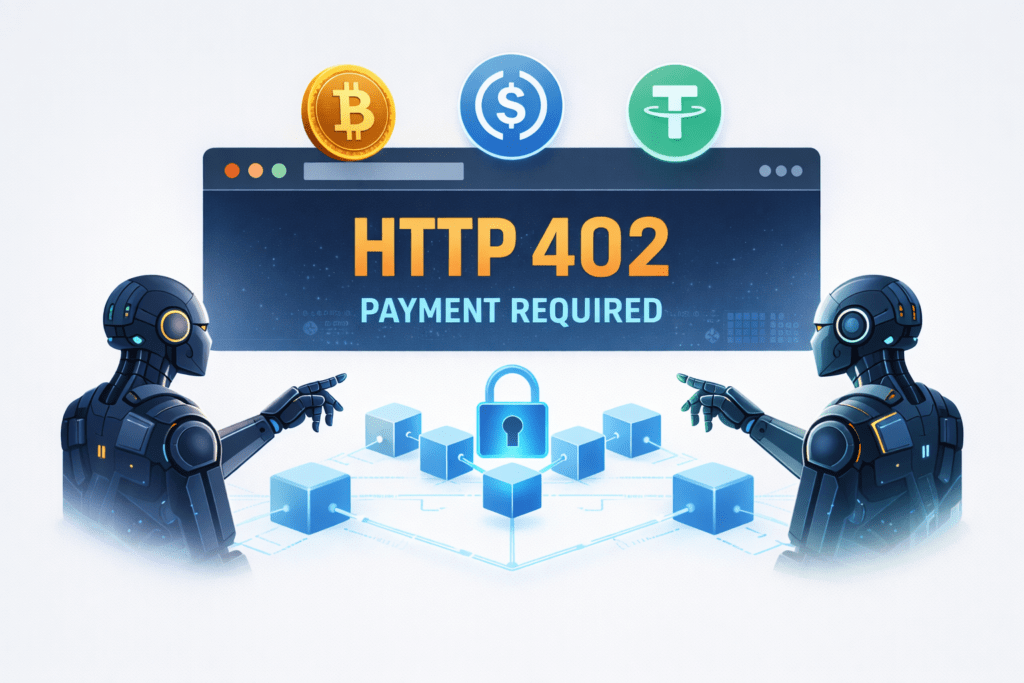
The internet was never fully finished. In its earliest design, engineers even reserved a status code for payments HTTP 402, “Payment Required.” The intent was obvious: one day, the web would need a native way to exchange value, just as easily as it exchanges information. That day never arrived. There were no payment rails, no cryptographic money, no secure way for browsers to settle value on their own. So for the next three decades, we improvised.
- Credit cards
- Subscriptions
- Aggressive ads
- Paywalls
- Layers of middlemen
The system worked well enough to build a multi-trillion-dollar digital economy, but it was never elegant and it was never native. Today, a protocol called x402 is quietly finishing what the original architects left unfinished, and in doing so, it may trigger one of the most important economic shifts since the birth of the internet itself.
The Internet was never designed to move money
x402 is stepping in to solve this structural flaw at the protocol level. By connecting stablecoin payments directly to web requests, it effectively gives the internet its own native wallet. This is far more than a simple fintech upgrade; it’s a foundational shift that enables seamless machine-to-machine commerce. When the web can finally settle value as easily as it shares information, the entire economic model of the digital world changes and that’s when things get truly interesting.
When payments stop interrupting thought
Humans hate micro-payments. No one wants to approve a transaction for fractions of a cent; that tiny pause; the mental effort required to click “confirm” is what economists call cognitive friction. It is the primary reason we settle for:
- $20 monthly subscriptions we barely use.
- Flat pricing for services we only consume sporadically.
Enter the Frictionless Agent
AI agents don’t have that problem. An agent utilizing x402 can execute thousands of tiny payments per second without hesitation, emotion, or fatigue. When payment friction disappears, economic activity doesn’t just increase; It accelerates.
From chunky payments to flowing value
Traditional finance works in batches. Credit card networks cannot process micro-transactions efficiently because fees destroy the economics. That is the fundamental reason why true pay-per-use models never took off.
x402 flips that model entirely. Value can now flow continuously, much like data packets.
The shift to precision
Instead of the old standards:
- Paying monthly for software
- Paying upfront for compute
Agents can now pay for exact usage:
- A single API call
- Three seconds of compute
- One paragraph of proprietary data
This represents a shift to streaming value rather than bundled access.
Why subscriptions were a temporary fix
Subscriptions weren’t created because they’re good for users. They exist because they were the only sustainable payment model available for a web without native money.
x402 removes that constraint.
A new economic model
In an agent-driven world:
- AI doesn’t “subscribe”
- It pays exactly for what it uses
- Only when it needs it
The economy shifts from selling access to selling outcomes. This represents a profound change in how software is built and price
Blockchain as the trust layer for autonomous agents
Giving autonomous software the ability to spend money raises an obvious question: How do you trust it? This is where blockchain stops being speculative and starts being essential infrastructure. When x402 payments are combined with smart contracts, three things become possible:
Immutable audit trails and programmable
Every transaction an agent makes can be permanently recorded and verified.
You don’t just give an agent money; you give it rules. For example:
- Spend up to $5 per day.
- Only spend on compute.
- Only pay if the task succeeds.
Trust without intermediaries
Machines can verify who they are paying without the need for banks, processors, or manual approvals.
This isn’t hype. It is governance for software.
When software becomes economically independent
For the first time in history, code can:
- Own money
- Earn revenue
- Pay expenses
- Operate independently
- Remain fully auditable by humans
This is sovereign software. These are not just human-controlled tools or runaway AI, but autonomous systems operating within clear, programmable boundaries.
x402 is the missing bridge between the Internet of Information and the long-promised Internet of Value. Once money becomes native to the web, everything built on top of it changes.
The Internet is finally learning how to charge
The most profound infrastructure changes rarely announce themselves. They do not arrive as products or platforms. They arrive as fixes to assumptions so old we forgot they were assumptions at all.
HTTP 402 was never a mistake. It was a placeholder.
Now, the web finally has the tools to complete it. And when it does, the economics of the internet will change not gradually, but fundamentally.